The short answer
A process is what, a procedure is how: who does what, when and in which order; a work instruction is how one task is done, step by step.
| Document | Answers | Holds | Changes when |
|---|---|---|---|
| Process | What happens and why, from trigger to result, and who hands off to whom | Trigger, result, the activities in order, a role for each | A step or a role is added or removed |
| Procedure | How: who does what, when and in which order | An owner per step, deadlines and triggers, scope, exceptions | A deadline, an owner or an exception changes |
| Work instruction | How exactly: one task, step by step at the screen | Clicks, field names, screenshots | The screen changes |
The process comes first. A procedure is always the way of carrying out a process, so there is nothing for it to specify until the process exists.
Below the work instruction sits the job aid: a one-page reminder cut from a work instruction or an SOP, for someone who has done the task before.
The task: a Northwind refund
Northwind is a made-up online shop with 12 people. Its support team issues refunds in Paynest, the web-based payments dashboard the shop uses. One rule shapes the task: support refunds up to 200 EUR alone; above that, finance approves in the ticket first. It is the same refund as in Process documentation, the job aid and example 2 of SOP examples.
Three parties take part: the customer, a support agent and finance. Three are enough for the process level to mean something; with one person doing everything, process and procedure collapse into a to-do list.
The refund as a process
Trigger: a customer asks for money back on a paid order. Result: the money returned, the customer told, the refund matched to the bank statement.
- Request Customer
- Check Support
- Approve Finance
- Refund Support
- Reconcile Finance
Five boxes, a role under each, and nothing else: no tool, no screen, no deadline. That matches the ISO 9000:2015 definition (clause 3.4.1) of a process as a "set of interrelated or interacting activities that use inputs to deliver an intended result" (nlfnorm.cz term list).
This level changes only when a box or a role is added or removed, for example if a manager had to approve large refunds.
The refund as a procedure
Scope: refunds on paid orders that a customer asks for. Not for unpaid invoices, which are voided instead, and not for chargebacks, which go to finance directly.
| Step | Who | When or trigger |
|---|---|---|
| Check the order, its status and the amount against the request | Support agent | Within 1 business day of the request |
| Approve the refund in the ticket, if it is over 200 EUR | Finance | When support asks for approval in the ticket |
| Issue the refund in Paynest (work instruction "Issue a refund on a paid order") | Support agent | The same day: after the check up to 200 EUR, after approval above |
| Paste the confirmation into the ticket, tell the customer, close the ticket | Support agent | Right after the refund is saved |
| Match the week's refunds to the bank statement | Finance | Every Friday |
The issue step names its work instruction instead of holding the clicks. Everything in the table is something a screenshot cannot show: an owner, a deadline, the order of the steps, the 200 EUR threshold, the chargeback exception.
ISO 9000:2015 (clause 3.4.5) defines a procedure as a "specified way to carry out an activity or a process" (Johner Institute). Note 1 to that clause adds that procedures can be documented or not (Auditor Training Online). A team that always refunds the same way has a procedure even before anyone writes it down.
This level changes when a deadline, an owner or an exception changes.
The refund as a work instruction
One procedure step, the support agent issuing the refund in Paynest, is six clicks and entries: type the order number in Search orders, click the order's row and check that it is Paid, open Actions, choose Issue refund, type the reason in Refund note, click Save refund. Three of the six, as recorded on order 10428:
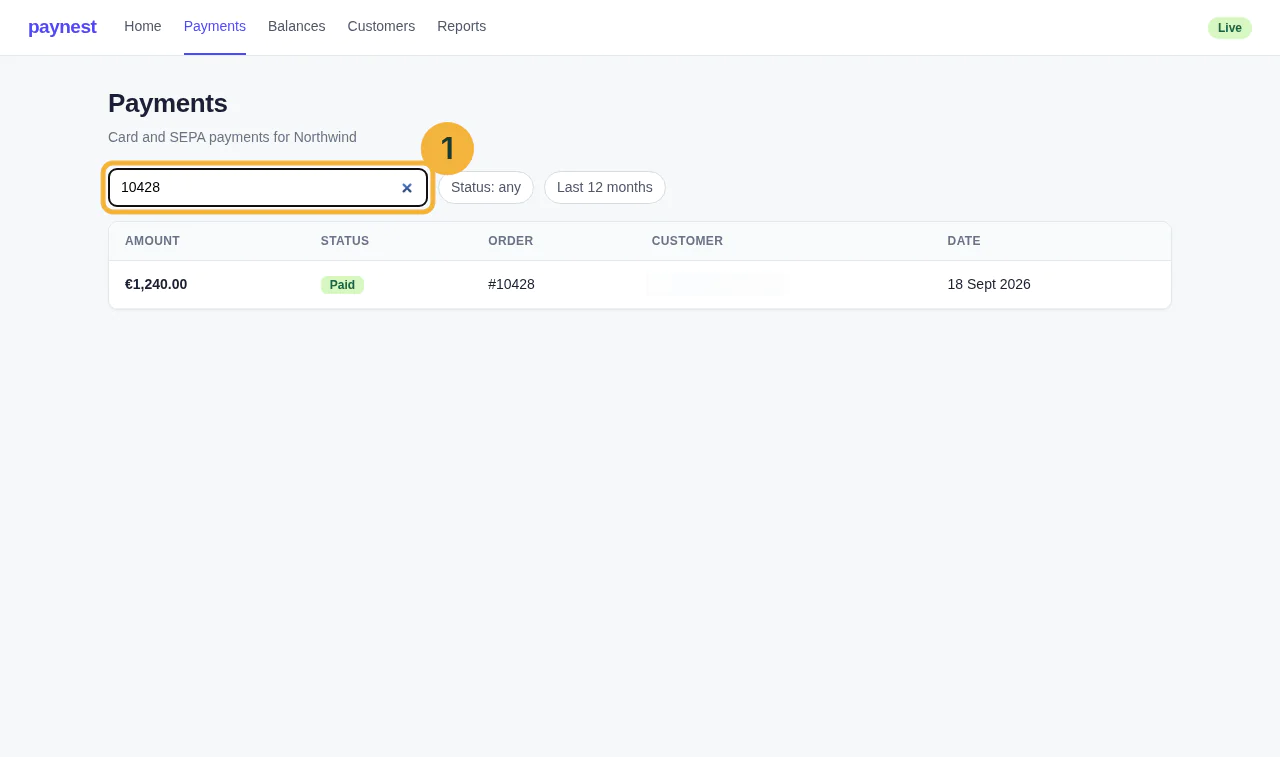
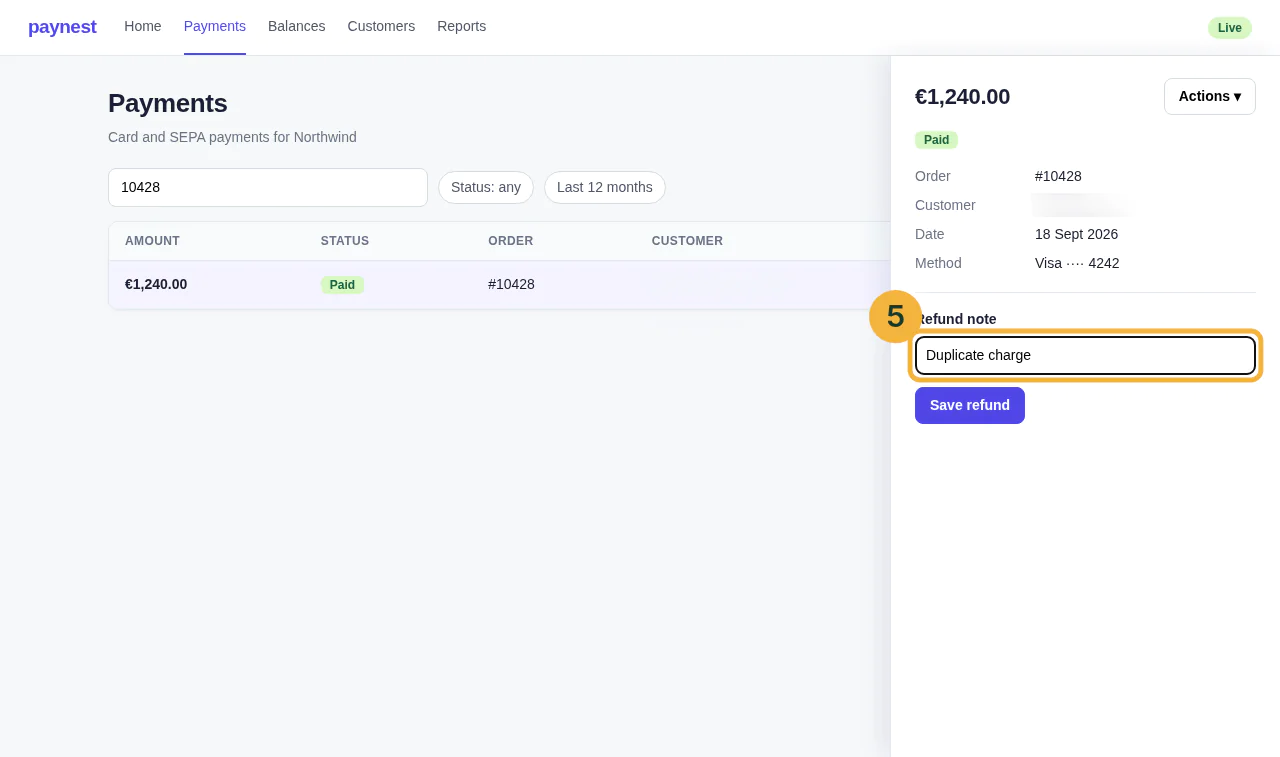
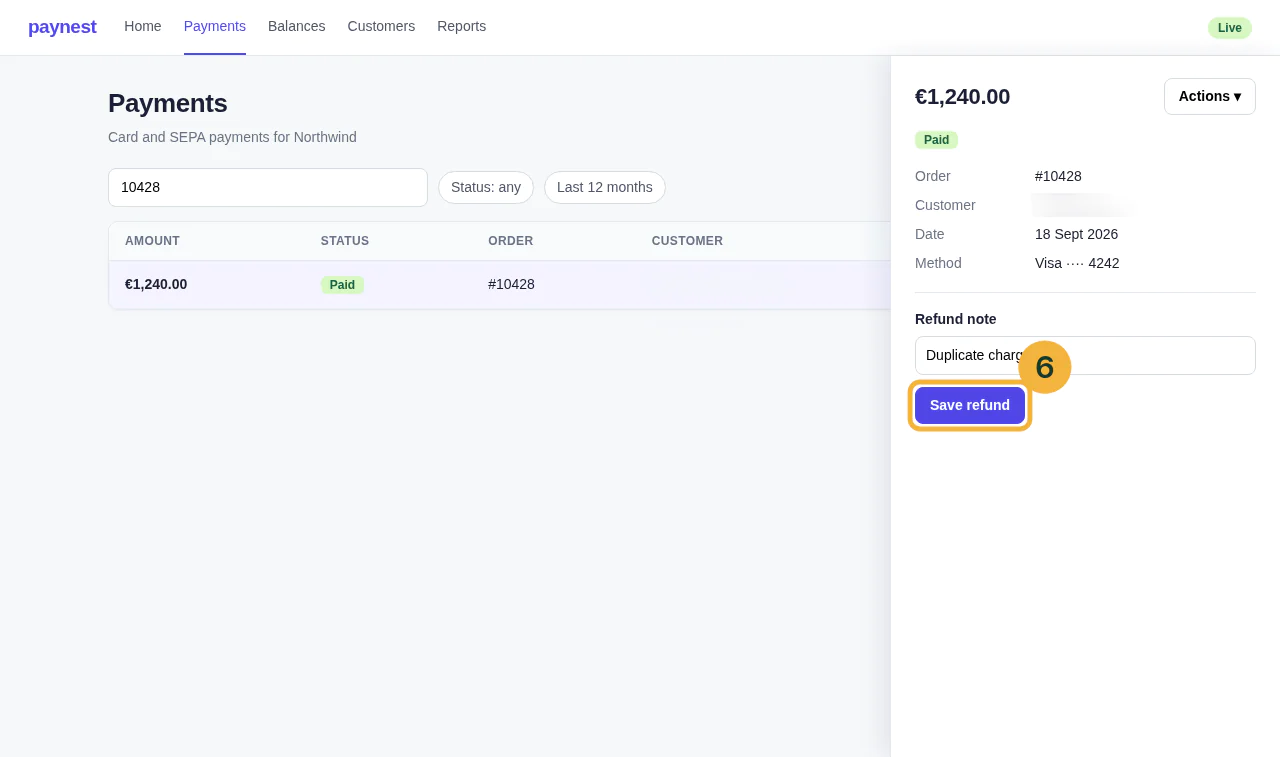
This level breaks when the panel is redesigned. The two levels above do not: the refund still goes request, check, approve, refund, reconcile, and support still refunds the same day. How to write and maintain this level is covered in SOP vs work instruction.
Rule of thumb: what, how, how exactly
To decide where a sentence belongs, ask what would make it wrong:
| The sentence goes out of date when | It belongs in the | Refund example |
|---|---|---|
| A role or a step is added | Process | "Finance approves large refunds before they are issued." |
| A deadline or an owner moves | Procedure | "Support checks the order within 1 business day." |
| A button is renamed | Work instruction | "Click Save refund." |
A process can run with no written procedure, and many do. Advisera's rule for when to write one: "when you have a process that needs to occur in one specific way, and you have specified how it is to happen, you have a procedure" (Advisera 9001Academy). Work that depends on judgement, such as answering an unusual complaint, often needs only the process.
Is an SOP a process or a procedure
A procedure: the name says so, standard operating procedure. An SOP is a procedure that has been written down and agreed.
In small teams one SOP often carries the clicks as well. That works, but the clicks age fastest, so keep them in their own section or in a linked guide, where a screen change touches one place. What is an SOP lists what goes in one.
What a written procedure contains
A written procedure (in German quality management, a Verfahrensanweisung) usually has six parts. Here they are for the Northwind refund:
| Part | What it says | Northwind refund |
|---|---|---|
| Purpose | Why the procedure exists | Pay customers back on paid orders, with the reason on record |
| Scope | What it covers, and what it does not | Customer refunds on paid orders; not unpaid invoices, not chargebacks |
| Responsibilities | Who owns which step, and who owns the document | Support agent: check, refund, close. Finance: approve over 200 EUR, reconcile. Document owner: head of support |
| Steps | Who does what, when and in which order | The five rows of the procedure table above |
| Related documents | What it points to | Work instruction "Issue a refund on a paid order", the refund policy, the reconciliation sheet |
| Revision history | Version, date, approver, what changed | One line per change, for example "v2: approval threshold set at 200 EUR" |
ISO 9001:2015 does not require a document of this name. It replaced the terms "documented procedure" and "record" with "documented information" (ISO 9001 Help, checked 4 October 2026), so whether a procedure is written down is the organisation's decision.
How other pages draw the line
The pages that rank for this question agree that a procedure is the how. They differ on where the clicks go:
- Two levels. The procedure holds the clicks too, and there is no separate work instruction. Navvia: "A process describes what, while a procedure describes how", a procedure being technology specific (Navvia).
- Three levels. The quality-management pyramid this page uses, with the work instruction as "the most detailed description of a task" (Due Process Consulting).
Under two levels, merge the procedure and work instruction sections above into one document.
A policy sits above all three and says what must always be true, such as "a refund over 200 EUR needs a second approver". Where a policy ends and a procedure starts is shown on one rule in Policy vs procedure.
Process vs procedure examples
| Work | Process line | Procedure line |
|---|---|---|
| Employee onboarding | HR hands the hire to IT, IT sets up accounts, the team lead runs the first week | HR enters the start date 10 business days before day one; IT has the accounts ready 2 days before |
| Granting system access | Request, approve, grant, confirm | The team lead requests by ticket; the system owner approves within 1 business day |
| Month-end invoice close | Collect invoices, reconcile, post, report | Accounts payable posts everything received by the last business day; the controller reconciles by the 3rd |
| IT incident handling | Report, triage, fix, close | The service desk logs every call as it comes in; the on-call engineer picks up priority 1 within 15 minutes |
| Customer refund | Request, check, approve, refund, reconcile | Support checks within 1 business day; finance matches the week's refunds to the bank statement every Friday |
Each procedure line names a who and a when. None names a button; that would be a work instruction.
In law and medicine
In US law, procedural due process is the constitutional requirement that governments "abide by certain procedures" to protect people's essential interests (Cornell LII). A medical procedure is a treatment. Neither sense is about documenting work.
Sources
All pages checked on .
- nlfnorm.cz term list: process (ČSN EN ISO 9000). ISO 9000:2015 clause 3.4.1, the definition of process.
- Johner Institute: Standard operating procedures in quality management. ISO 9000:2015 clause 3.4.5, "specified way to carry out an activity or a process".
- Auditor Training Online: Management systems, what needs to be documented, part 1. Note 1 to 3.4.5: procedures can be documented or not.
- Advisera 9001Academy: ISO 9001:2015 process vs procedure, some practical examples. Not every process needs a procedure.
- ISO 9001 Help: ISO 9001:2015 documentation. "Documented procedure" and "record" replaced by "documented information".
- Navvia: Process vs procedure, what is the difference. The two-level usage: procedure as the tool-specific how.
- Due Process Consulting: Is it a policy, a procedure, an SOP or a work instruction. Policies, procedures, SOPs and work instructions, from general to detailed.
- Cornell Law School LII: procedural due process. The legal sense, one sentence only.